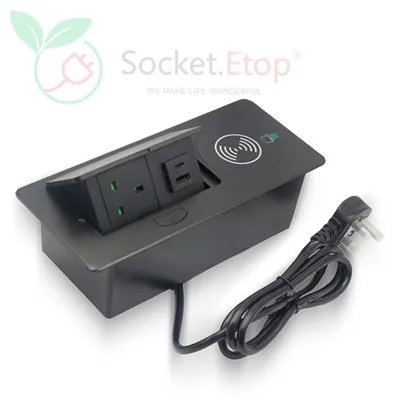
Wall sockets and extension cords share some similarities in function, but there are also differences.
Wall sockets are fixedly installed on the wall of a building, with a relatively fixed location. They provide a stable power connection for appliances, suitable for appliances used long-term, such as televisions and refrigerators. Their advantage is stable power supply, not easily affected by external forces. Extension cords, on the other hand, are movable and can be conveniently used in different locations. They are suitable for appliances that need to be moved frequently, such as table lamps and small fans. The convenience of extension cords lies in their flexibility in adjusting their location. However, extension cords usually have a relatively lower power capacity, and problems such as loosening of the plug may occur during movement due to pulling or other factors.
1. Power Supply Stability
- Wall sockets are generally directly connected to the building's power supply line, ensuring a relatively stable power supply. As long as the building's power system is functioning properly, wall sockets can continuously and stably power appliances. For example, a refrigerator plugged into a wall socket will run smoothly with minimal power supply issues.
- While extension cords can also provide power, their relatively long and movable internal wiring can cause poor contact between the plug and socket during movement, affecting power supply stability. For instance, sometimes after an extension cord is dragged around on the floor, the connected appliance may suddenly lose power.
2. Power Capacity
- Wall sockets can typically handle higher-power appliances. High-power appliances such as electric water heaters and microwave ovens generally need to be connected to wall sockets because their wiring and interface design are better suited to meet the power demands of these appliances.
- Extension cords have relatively limited power capacity. Common extension cords are generally suitable for connecting lower-power appliances, such as mobile phone chargers and small speakers. Connecting high-power appliances to them may cause the extension cord to overheat or even pose a safety hazard.
3. Flexibility of Use
- Wall sockets have fixed locations, requiring appliances to be placed close to them. For example, a television can only be placed near the wall with the socket, limiting its usability.
- Extendable sockets can be moved freely to where needed. For instance, when reading in the bedroom, a lamp connected to an extendable socket can be moved to the bedside; during a gathering in the living room, an extendable socket connected to a small fan can be moved to the center of the group for convenient use.