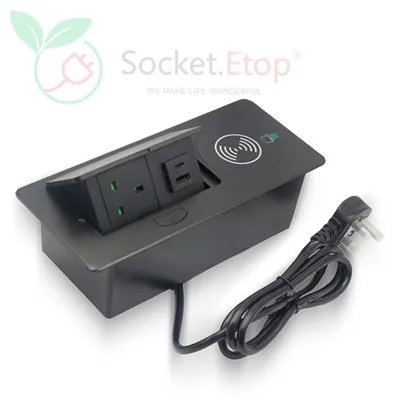
What is the diameter of the opening for the pneumatic Push pop up socket?
Cut-Out / Opening Diameter: For this pneumatic push pop-up socket specification, the standard opening diameter is 100–102 mm (always verify exact model tolerances on the manufacturer's cut-out template before drilling).
Compatible Countertop Thickness: Typically 15–45 mm (depending on thread length and clamping hardware). Ultra-thin slabs-such as standalone 12 mm sintered stone-may require a backing board or thin-countertop spacer to clamp securely.
Sintered Stone & Marble Compatibility: Yes. Both sintered stone and natural marble can host a pneumatic push pop-up socket when fabricators use water-cooled diamond core bits, preserve safe edge/cut-out clearances, verify clamping/backing thickness, and seal the perimeter against moisture and spills.


Industry Guide: Pneumatic Push Pop-Up Sockets
1. Operating Principle & Market Positioning
A pneumatic push pop-up socket is a concealed power and data/charging terminal widely specified for kitchen islands, sideboards, breakfast bars, hospitality counters, and executive desks. Unlike motorized pop-up units that rely on electric motors, lead screws, and dedicated control electronics, a pneumatic push mechanism uses a calibrated gas spring (pneumatic strut) and controlled damping/latching assembly. A gentle press on the top cap releases the latch so the gas spring smoothly elevates the tower; pressing it back down engages the lock until the top sits flush with the surface.
Because the lifting motion is purely mechanical and pneumatic, these units offer a clean, self-contained form factor with no extra motorized drive electronics to power or service, quick tactile actuation, and straightforward integration. In contemporary minimalist interiors, they solve practical layout challenges-bringing power close to prep zones and workstations without leaving fixed wall outlets out of reach or cluttering surfaces with bulky power strips and trailing cords. On the manufacturing side, an experienced Hydraulic lifting socket factory often applies precision damping, controlled extension, and durable seal engineering across concealed lift-and-retract hardware so daily raising and lowering stays smooth and reliable over time.
2. Cut-Out Diameter, Countertop Thickness & Under-Counter Clearance
Accurate dimensional coordination between the hardware, countertop fabricator, and cabinet maker prevents costly on-site rework. For a pneumatic push pop-up socket rated for a 100–102 mm opening, three dimensional parameters matter most:
Cut-Out Diameter & Tolerance (100–102 mm): This window balances smooth insertion of the cylindrical housing with reliable overlap under the top trim flange. A hole that is too tight can bind the cylinder or risk damaging the bezel and internal glide tracks during installation; a hole that is too wide reduces clamping engagement on the underside locking nut/ring and leaves minimal margin for error around the rim.
Countertop Thickness Range: Most standard designs fit countertops roughly 15–45 mm thick (depending on thread length and clamping hardware). If a countertop is thinner than the minimum clamping range, the locking ring may bottom out before achieving firm tension unless paired with a backing board or shim ring. Conversely, an overly thick slab can leave too little thread engagement underneath.
Under-Counter Depth & Cable Routing: Even when closed, the housing extends downward into the cabinet cavity, and the power cord needs space for a safe bend radius without kinking or pressing against hardware. Installers must check for interference with drawer slides, pull-out baskets, dividers, or structural stretchers beneath the cut-out.
3. Installing on Sintered Stone and Marble
Installing round cut-outs in sintered stone and natural marble is routine in modern kitchen and commercial projects, but brittle stone behavior requires disciplined fabrication and mounting practices:
Water-Cooled Diamond Core Drilling: Sintered stone is dense, hard, and prone to edge chipping or thermal stress if cut dry or with aggressive percussion tools, while marble can contain natural veins, fissures, and localized brittleness. Fabricators should use a 100–102 mm diamond-grit core bit with continuous water cooling and steady feed pressure to produce clean, chip-free edges and accurate diameter control.
Edge & Feature Clearances: Keep the circular cut-out well clear of countertop edges, corners, miter seams, sink basins, and cooktop openings. Concentrating multiple cut-outs or placing one too close to a narrow stone bridge creates stress risers that can crack under thermal shifts or heavy daily impacts.
Reinforcement for Thin Slabs: Thin sintered stone slabs (such as 12 mm panels) often lack rigidity and sufficient thickness for standard clamping hardware on their own. Bonding the stone to a suitable substrate or using manufacturer-approved mounting hardware helps distribute clamping pressure evenly without stressing the stone.
Moisture & Spill Sealing: Kitchen islands and wet bars expose countertops to splashes, steam, and cooking oils. Applying a clean, appropriate sealant around the contact seam helps keep liquids from seeping through the cut-out edge into the cabinet interior or near electrical connections below.
4. Specification, Safety & Project Coordination Best Practices
Beyond cut-out dimensions and stone fabrication, successful specification depends on electrical compliance, functional detailing, and practical load planning. Choose units built with recognized safety certifications, flame-retardant housings, proper grounding, and built-in surge or overcurrent protection suited to the target market. Where crumbs, flour, or cooking splashes are common around a prep island, working with a reliable Ac Brushed Plug Socket supplier can help address cable-entry debris and dust resistance while keeping cord routing tidy when the unit is in use. At the same time, buyers sourcing Hidden Kitchen Power Outlets wholesale for residential or commercial projects increasingly look for multi-device convenience-such as Electrical Sockets with Pd Fast Charging OEM configurations that pair standard AC outlets with USB-C Power Delivery ports while preserving safe electrical isolation and thermal clearance.
In high-use kitchen environments, look for splash-resistant designs and avoid plugging multiple high-draw heating appliances-such as air fryers, kettles, or induction plates-into a single concealed outlet beyond its rated load. Finally, lock in the exact socket model and dimensional drawing before finalizing countertop fabrication and cabinet layouts so cut-outs, clearances, and power feeds align on the first pass.