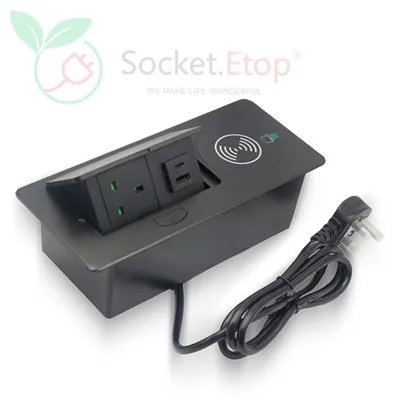
Installing a wall-mounted power outlet requires caution to ensure safety. Here are the key steps:
Prepare Tools and Materials
Before installation, gather tools such as a screwdriver, a voltage tester (test pen), and electrical tape, along with a wall outlet that meets specifications. Ensure the outlet is of good quality and bears the 3C certification mark. Also, select the appropriate type of outlet for the location (e.g., with or without a switch).
Cut Off the Power
You must cut off the power supply first; locate the main circuit breaker and turn it off to prevent electric shock during installation. Use a voltage tester to confirm there is no live current before proceeding with the next steps.
Identify and Connect Wires
Open the back cover of the outlet. In standard household wiring, the red wire is the live wire, the dual-colored wire (e.g., yellow and green) is the ground wire, and the blue wire is the neutral wire. However, as wiring colors may not always follow standard conventions in every home, you must use a voltage tester to verify the live and neutral wires. Connect the live wire to the terminal marked "L," the neutral wire to the terminal marked "N," and the ground wire to the terminal marked "E" or the ground symbol. When connecting, strip the appropriate length of insulation from the wires, insert them into the terminals, and tighten the screws with a screwdriver to ensure a secure, firm connection.
Secure the Outlet
Align the outlet with the pre-existing mounting holes on the wall and secure it using screws. Ensure the screws are tightened properly so that the outlet is mounted stably and does not wobble.
Inspection and Power-On Test
After installation, carefully check that all wiring connections are correct and secure, and ensure there are no exposed wires. Once verified, turn on the main household circuit breaker. Use a voltage tester or an electrical appliance to confirm that the power strip is supplying power correctly and that the switch functions properly (if the unit is equipped with a switch).
Installing wall-mounted power strips involves certain risks. If you lack electrical knowledge or experience, it is recommended to hire a professional electrician to perform the installation to ensure electrical safety.